




Bingo!
A Practical Guide to Playing All Seven Tiles and Banking the Bonus
By Lex with Raj Naik · xSoft Ltd · 2026
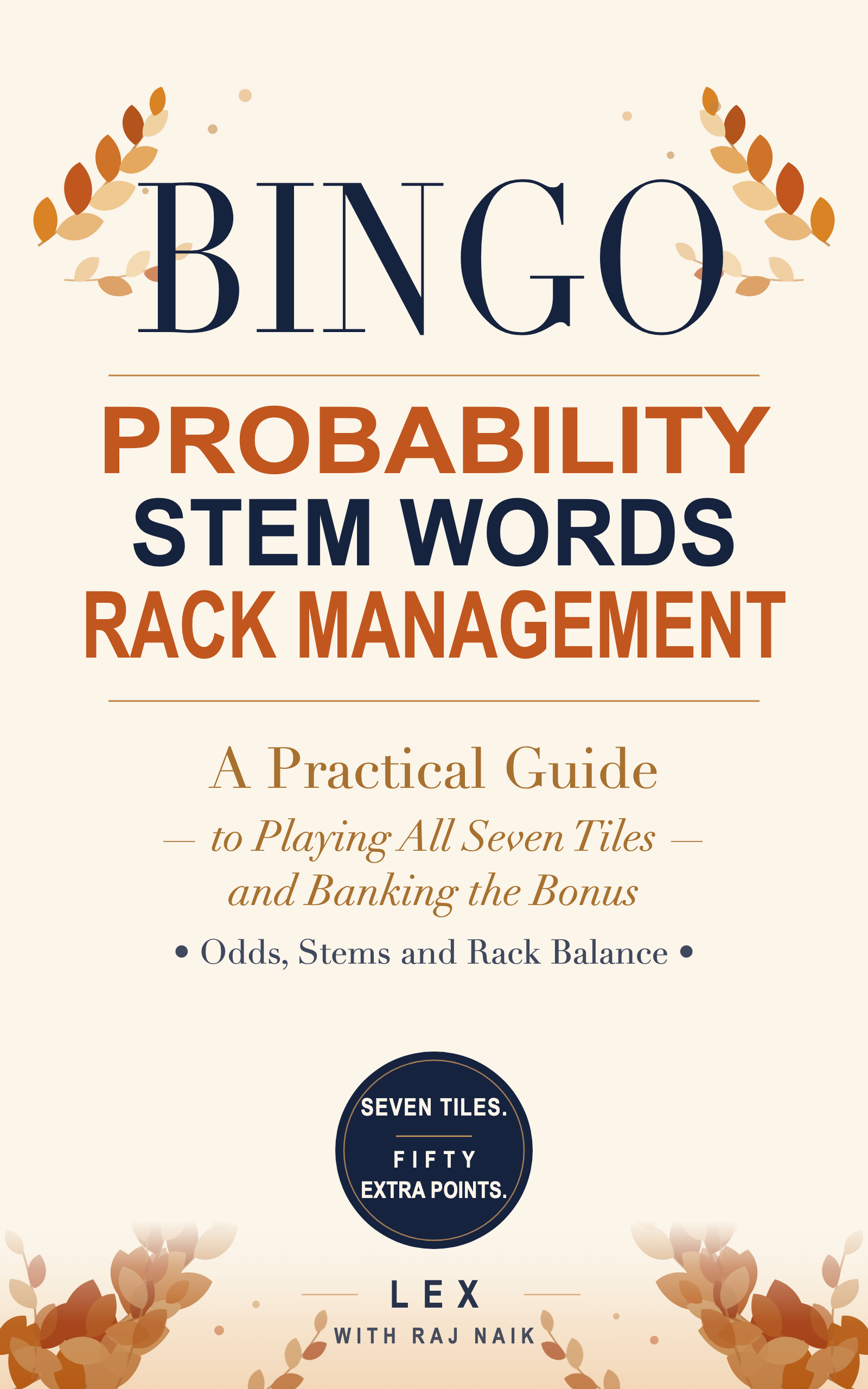
The 50-point bonus for using all seven tiles in a single turn is the most powerful scoring opportunity in competitive word games. This book teaches you to find bingos, set them up, and play them consistently. 14 chapters covering stems, probability, rack management, anagramming, and game-day strategy.
Table of Contents
Part 1: Why Bingos Matter
Part 2: Bingo Stems
Part 3: Rack Management
Part 4: Finding the Bingo
Part 5: Statistics & Probability
Part 6: Putting It Together
Part 1
Why Bingos Matter
Chapter 1: The 50-Point Swing
A bingo scores the base value of the word plus a 50-point bonus. The average bingo scores between 70 and 85 total points — the equivalent of two to three normal turns compressed into one. In a game where the total points available hover around 700, a single bingo represents more than 20% of your expected total.
The scoring mathematics are stark. In competitive play, the average non-bingo turn scores 25–35 points. A bingo typically scores 70–85. That's a 40–55 point advantage over what you would have scored with a shorter play — not just the bonus, but the full value of deploying all seven tiles at once.
Win Rate Correlation
Analysis of tournament data reveals a clear, linear pattern: players who bingo more frequently win more games. At the highest levels of competitive play, top-ranked players average 2–3 bingos per game. Club-level players average 0.5–1. Casual players often go entire games without a single one.
This isn't simply because stronger players know more words (though they do). It's because they have systematically trained themselves across four distinct skills:
1. Recognition: They spot when their rack contains a bingo possibility — often within seconds of drawing tiles.
2. Setup: They manage racks over multiple turns to create bingo-ready configurations.
3. Finding: They locate the bingo under time pressure when one exists in their tiles.
4. Placement: They find where the bingo fits on the board, even when space is limited.
Each of these skills is trainable. None requires memorising the entire dictionary. This book teaches all four.
The Psychological Impact
Beyond the raw points, a bingo shifts momentum. Your opponent sees a 7-letter word played confidently, knows they've just lost 70+ points of equity, and often begins playing defensively — which compounds the disadvantage. A bingo doesn't just score well; it changes the emotional state of the game.
There's also a self-reinforcing effect: once you play your first bingo, you're more relaxed. You know you can do it. That confidence makes you play more fluidly on subsequent turns, which paradoxically makes your next bingo more likely (because you manage your rack with less anxiety).
How Many Bingos Should You Expect?
| Level | Bingos/Game | Notes |
|---|---|---|
| Casual | 0–0.5 | Mostly accidental discoveries |
| Club | 0.5–1 | Some deliberate rack management |
| Tournament | 1–2 | Active bingo hunting every turn |
| Expert | 2–3+ | Consistent management + deep vocabulary |
Goal
This book aims to move you one level up — whatever your current bingo frequency. From casual to club. From club to tournament. From tournament to expert.
Chapter 2: The Mathematics of the 50-Point Bonus
Expected Value: Bingo vs. Best Alternative
When you have a rack that contains a bingo, the decision to play it seems obvious. But there are situations where the best bingo play scores less than an alternative shorter play — because the shorter play hits premium squares the bingo can't reach, leaves a better rack for the next turn, or blocks the opponent's access to a dangerous position.
Understanding when to not play a bingo is as important as finding one. The decision framework is expected value: the bingo's immediate score minus the positional cost, compared to the alternative's score plus its future value (the "leave equity").
In practice, the bingo is the correct play roughly 85% of the time when one exists. But that 15% matters — it separates a good player from a great one. Common situations where you might skip the bingo:
- The bingo opens a Triple Word Score for your opponent with no way to block
- An alternative play scores within 15 points of the bingo AND gives you a leave of SATIRE-letters
- You're ahead by 80+ points and the bingo opens the board dangerously
- The bingo is on a spot where your opponent can hook off it for massive points
Score Differentials Over a Full Game
Consider two players of equal vocabulary who play 15 turns each in a 30-turn game:
Player A (no bingos)
15 turns × 30 points avg = 450 points
Player B (2 bingos)
13 turns × 28 pts + 2 bingos × 75 pts = 514 points
Player B wins by 64 points — despite averaging fewer points on non-bingo turns (because bingo-hunting sometimes requires sacrificing a few points for better leave). The bingos more than compensate for the slightly lower average on other turns.
The Bingo Gap
What separates club players from tournament winners isn't vocabulary size (most club players know enough words). It's bingo frequency. A player who bingos once per game averages 50 more points than one who bingoes once every two games. Over a tournament of 20+ games, that's 1,000+ points of aggregate advantage — enough to determine final standings.
This is why bingo training is the single highest-ROI improvement activity for any player above beginner level. An extra bingo per game is worth more than knowing 500 additional obscure words that you'll encounter once in 100 games.
Key Insight
Over a 20-game tournament, the player who averages one extra bingo per game gains ~1,000 points of cumulative advantage. This is often the difference between finishing 1st and finishing 10th.
Part 2
Bingo Stems — Your Foundation
Chapter 3: What Is a Bingo Stem?
A bingo stem is a six-letter combination that, when you add one more letter, forms a valid seven-letter word. The most productive stems form words with many different add-letters — sometimes 10 or more distinct bingos from a single stem.
Why Stems Work
The English language has structure. Certain letter combinations appear frequently in 7-letter words because they form common word roots, prefixes, and suffixes. A stem captures that structure: if you hold six of the right letters, the seventh letter drawn from the bag will often complete a valid word.
The mathematics are straightforward. There are about 35,000 valid 7-letter words in SOWPODS. The top 10 stems each generate 15–30+ distinct words. Memorising just 10 stems gives you pattern recognition for hundreds of bingos — without memorising each individual word.
Think of it like learning music scales. A guitarist who knows the pentatonic scale can improvise thousands of melodies without memorising each one individually. Stems work the same way — they give you a framework for recognising bingo possibilities instantly.
The Top 10 Stems
Ranked by productivity — the number of valid 7-letter words each stem produces when a single letter is added:
| # | Stem | Key Add Letters | Example Words |
|---|---|---|---|
| 1 | SATIRE | B,C,D,G,L,M,N,P,W | NASTIER, RETINAS, STAINER |
| 2 | RETAIN | B,C,D,E,G,L,M,O,P,S | TRAINED, CERTAIN, DETRAIN |
| 3 | TISANE | B,C,D,G,L,M,P,R,W | INSTEAD, ANTSIER, STAINED |
| 4 | SALINE | B,C,D,G,H,K,M,R,T,W | SALTINE, NAILERS, ALINERS |
| 5 | ORNATE | B,C,D,G,I,L,P,S | SENATOR, TREASON, NEGATOR |
| 6 | SENIOR | C,D,G,L,M,P,T,V,W | EROSION, VERSION, REGIONS |
| 7 | ARISEN | B,C,D,G,L,M,P,T,W | REMAINS, SEMINAR, SARDINE |
| 8 | TENORS | B,C,D,G,H,I,L,M,P,W | MONSTER, MENTORS, HORNETS |
| 9 | ALERTS | B,C,D,G,H,I,M,N,O,P,W | SLATHER, SALTIER, REALIST |
| 10 | SORTIE | B,C,D,G,L,M,N,P,W | STORIES, STORIED, LOITERS |
The "Add Letter" Concept
When you hold a stem in your rack, any seventh tile that's a valid add-letter completes a bingo. The more add-letters a stem has, the more likely you are to draw one from the bag. SATIRE has valid add-letters B, C, D, G, L, M, N, P, W — that's 9+ letters that complete a bingo.
Given random draws from the remaining tiles, the probability of holding a bingo after drawing your seventh tile is significantly higher when your six tiles form a productive stem. This is why stem knowledge transforms bingo frequency — you're not hoping for luck; you're engineering probability in your favour.
Chapter 4: The SATIRE Family
SATIRE is the single most productive bingo stem in the English language. It produces more valid 7-letter words than any other six-letter combination. Understanding SATIRE deeply teaches you how ALL stems work — because the principles of recognition, add-letter scanning, and word construction are identical across every stem.
The letters S-A-T-I-R-E appear in dozens of 7-letter words because they form common English word components: RE- (prefix: again), -STER (suffix: one who does), -ATE (suffix: to make), -IST (suffix: practitioner), and -IER (suffix: more).
SATIRE + Each Add Letter
SATIRE + B → BAITERS, REBAITS, BARITES
B appears twice in the bag. These words end in -S (hookable for extra points).
SATIRE + C → RACIEST, STEARIC, CRISTAE
C appears twice. RACIEST ("most racy") is the easiest to spot and remember.
SATIRE + D → TIRADES, ARIDEST, DISRATE, ASTRIDE, STAIDER
D is very common (4 tiles). TIRADES is familiar vocabulary. Multiple options = you'll almost always find one.
SATIRE + G → STAGIER, AIGRETS, GAITERS, SEAGIRT
G appears 3 times. GAITERS (leg coverings) is the most memorable.
SATIRE + L → REALIST, SALTIER, RETAILS, TAILERS
L is very common (4 tiles). REALIST and RETAILS are everyday words — impossible to forget.
SATIRE + M → MAESTRI, SMARTIE, MISRATE
MAESTRI (plural of maestro) is worth memorising. Unusual enough that opponents may challenge incorrectly.
SATIRE + N → NASTIER, ANTSIER, RETINAS, STAINER, RATINES
N is extremely common (6 tiles!). NASTIER is instantly recognisable. Statistically the most likely bingo from SATIRE.
SATIRE + P → PARTIES, PASTIER, PIASTER, PIRATES, TRAIPSE
P appears twice. PARTIES and PIRATES are everyday vocabulary — easy to recognise under pressure.
SATIRE + W → WAISTER, WAITERS, WARIEST
W appears twice. WAITERS is obvious once you see it — the kind of word you kick yourself for missing.
Practice: Recognising SATIRE in Any Rack
The key skill is recognising when your rack contains the SATIRE letters (or an anagram: STRIAE, AIREST, etc.) among seven tiles. Try this:
Look at your rack: E, T, N, A, R, S, I
Do you see SATIRE? (Yes: S-A-T-I-R-E, with N left over)
SATIRE + N = NASTIER, RETINAS, STAINER — play the one that fits the board best.
The recognition becomes automatic with practice. Within a few weeks of daily drills, you'll spot SATIRE (and its anagrams) instantly in any rack that contains those six letters. Your brain trains itself to scan for the pattern — it becomes as natural as recognising a face.
Chapter 5: The Next Nine
After SATIRE, nine more stems complete the "essential ten." Each shares the property of high productivity — many valid add-letters, many resulting words, and letters that appear frequently in the tile bag.
RETAIN (anagram: RETINA)
Contains RE- (common prefix) + -AIN (common ending). Extremely versatile with 10+ add-letters.
Key words: D → TRAINED, DETRAIN; C → CERTAIN, CREATIN; S → RETINAS, NASTIER; L → LATRINE, RATLINE; G → TEARING, GRANITE
Memory hook: "RETAIN your tiles and RETINA will appear." The anagram connection makes both forms easy to remember.
TISANE (a herbal tea)
Contains TI- and -ANE endings. Often overlooked because the word itself is less familiar to casual players.
Key words: R → NASTIER (overlap with SATIRE!); D → INSTEAD, DETAINS; G → SEATING, INGESTA; L → SALTINE, ELASTIN
Memory hook: "Have a TISANE while you study bingo stems." The calm ritual of tea maps to the calm focus of stem study.
SALINE (salty)
Contains -INE and SAL- components. Very productive with common consonants.
Key words: T → SALTINE, ELASTIN; R → NAILERS, ALINERS; D → DENIALS, SNAILED; G → SEALING, LINAGES
ORNATE (decorative)
Contains -ATE (extremely common suffix) and OR- prefix. Particularly strong with S (SENATOR, TREASON) since S is one of the most common tiles.
Key words: S → SENATOR, TREASON; I → OTARINE; D → TORNADE; L → REALTONE
SENIOR (older person)
Contains -IOR ending and SEN- beginning. Produces many words in the -TION/-SION word family.
Key words: V → VERSION; T → STONIER, NORITES; G → IGNORES, REGIONS
ARISEN (past participle: risen)
Similar productivity to SATIRE because it shares 5 of 6 letters with it. The ARI- beginning and -EN ending make it versatile.
Key words: M → REMAINS, SEMINAR; D → SARDINE, RANDIES; G → EARINGS, REGAINS
TENORS (singers)
Contains -ORS ending and TEN- beginning. Very friendly with common consonants M, H, D.
Key words: M → MENTORS, MONSTER; H → HORNETS, SHORTEN; D → SNORTED, RODENTS
ALERTS (warnings)
Contains -TS ending and ALE- beginning. Its letters are all extremely common tiles, so this stem appears naturally in racks more often than most.
Key words: I → REALIST, SALTIER; H → HALTERS, LATHERS; N → RENTALS, ANTLERS
SORTIE (a military sally)
Contains -IE ending and SORT- beginning. Good overlap with STORIES and STORIED.
Key words: N → NORITES, STONIER; D → STORIED, EDITORS; L → LOITERS, ESTRIOL
The 3-Week Memory System
Learn the stems in groups of three (one week per group):
Week 1
SATIRE · RETAIN · TISANE
The "big three" — most overlap
Week 2
SALINE · ORNATE · SENIOR
The "middle tier"
Week 3
ARISEN · TENORS · ALERTS · SORTIE
The "completers"
Chapter 6: Beyond the Top 10
The top 10 stems cover the most common letter combinations, but productive stems extend well into the top 50. You don't need to memorise all 50 — the diminishing returns set in quickly. Instead, learn stems that match your personal weak spots.
The "Partial Stem" Technique
Sometimes you hold 5 of a stem's 6 letters plus two other tiles. The partial stem technique catches bingos the full-stem approach might miss:
Recognise the 5-letter fragment (e.g., STIR_ from SATIRE minus A or E)
Check if either of your remaining tiles completes the full stem
If yes, check if the 7th tile is a valid add-letter for the completed stem
Consonant-Heavy Stems
When your rack is consonant-heavy (too few vowels), standard stems like SATIRE won't help. Instead, look for patterns that work with limited vowels: -MENTS endings, -NESS endings (if you have a double letter), or compound consonant clusters like STR-, SCR-, SPR-.
Vowel-Heavy Stems
Racks like AEEIOU + one consonant rarely form stems at all. The better strategy here is to dump 2–3 vowels on this turn (even at low score) and build toward a stem on the next turn. Your leave of strong consonants + 1–2 vowels will draw well.
Part 3
Rack Management for Bingos
Chapter 7: The Perfect Rack
Not all seven-tile combinations are equal. Some racks virtually guarantee a bingo; others make one impossible regardless of your vocabulary. Understanding what makes a rack "bingo-ready" is the foundation of deliberate rack management.
The Ideal Composition
The "bingo letters" — tiles that appear most frequently in valid 7-letter words — are: E, S, R, A, T, I, N. Note that these are the exact letters of SATIRE + N. A rack containing 4–5 of these letters with a balanced vowel-consonant mix is "bingo-ready."
The ideal ratio:
- 2–3 vowels (ideally from {A, E, I})
- 4–5 consonants (ideally from {S, T, R, N, L, D})
- No duplicate letters
- No "dead weight" (Q without U, V without support, multiple of same vowel)
Rating Your Rack (0–100)
You can mentally rate any rack on a "bingo potential" scale:
| Score | Meaning | Action |
|---|---|---|
| 80–100 | Contains a known stem + good add-letter | Hunt for bingo NOW |
| 60–79 | Good balance, 4+ bingo letters present | Bingo possible — search carefully |
| 40–59 | Acceptable balance but missing key letters | Play to improve your leave |
| 20–39 | Imbalanced (too many vowels/consonants, dupes) | Dump bad tiles aggressively |
| 0–19 | Disastrous (QVWUOOI type) | Exchange or play any word to reset |
The "Keep or Dump" Decision
Every turn, before looking for plays, ask: "What do I want my rack to look like AFTER this turn?" If your current rack rates 60+, prioritise finding a bingo THIS turn. If 40–59, look for a play that scores decently AND improves your leave. If below 40, prioritise dumping bad tiles — even if it means scoring only 10–15 points this turn.
The Core Principle
Every play is two decisions: what you score NOW and what you keep for LATER. Expert players willingly sacrifice 5–15 points for a dramatically better leave.
Chapter 8: Rack Leave Strategy
The Leave Principle
Every play is actually TWO decisions: what tiles you PUT ON THE BOARD (scoring this turn) and what tiles you KEEP IN YOUR RACK (setting up next turn). The tiles you keep — your "leave" — determine your probability of bingoing next turn.
Expert players routinely sacrifice 5–15 points on a play to keep a dramatically better leave. Over a full game, this strategy nets +40–60 points compared to always playing the highest-scoring word regardless of leave.
Best vs. Worst Leaves
Excellent Leaves
- SATI (4 of SATIRE) — 2 tiles from a bingo
- ERN or EST — common word endings
- RE- or -ING — strong prefix/suffix
- Balanced 2–3 tiles, no duplicates
- A blank tile (always excellent)
Terrible Leaves
- QV — dead tiles with no synergy
- UU or VV — duplicate problems
- OOIA — too many vowels
- WKJ — no common combinations
- Any duplicate of a rare letter
The "Bingo in Two Turns" Strategy
Sometimes your best play is deliberate setup:
Turn 1: Play a short word (15–20 points) that dumps your worst tiles and keeps your best 4–5.
Turn 2: Draw 2–3 new tiles that (probably) complete a bingo.
This strategy works when your current rack has 4–5 excellent tiles and 2–3 terrible ones, the board position is likely to remain open next turn, and your opponent is unlikely to bingo first.
Chapter 9: Tile Tracking
The 100-Tile Distribution
Every game uses exactly 100 tiles with a known distribution:
A×9 · B×2 · C×2 · D×4 · E×12 · F×2 · G×3 · H×2 · I×9 · J×1 · K×1 · L×4 · M×2 · N×6 · O×8 · P×2 · Q×1 · R×6 · S×4 · T×6 · U×4 · V×2 · W×2 · X×1 · Y×2 · Z×1 · Blank×2
Why Tracking Matters for Bingos
If you're holding SATIR? (5 of the SATIRE stem + an unknown), you want to know: are there still E tiles in the bag? If all 12 E's have been played, you can't complete SATIRE — time to look for a different stem or play your tiles differently.
Tracking also tells you which add-letters are still available for your stem, whether your opponent might be holding a bingo (if many bingo-letters are still out), and whether it's worth "fishing" (playing a short word hoping to draw specific tiles).
Simple Tracking Methods
The Tally Sheet
Keep a grid of A–Z. Mark each letter as it's played on the board. What's unmarked is still in the bag or opponent's rack.
The "Remaining Pool" Method
Track only the important tiles: S (4 total), blank (2 total), and your stem-completion letters. Know how many are still out.
The Endgame Count
When the bag is empty: 100 − board tiles − your tiles = opponent's exact tiles. Bingo calculation becomes deterministic.
Late-Game Bingo Hunting
The most satisfying bingo is one you KNOW exists because you've tracked tiles perfectly. When the bag is empty and you know exactly what your opponent holds, you can calculate whether a bingo exists in any possible sequence of future plays. This transforms the endgame from guesswork into chess.
Part 4
Finding the Bingo
Chapter 10: The Art of Anagramming
You're holding 7 tiles. A bingo exists somewhere in those letters. How do you find it? Expert players use a systematic 4-step approach — not random mental shuffling.
The 4-Step Bingo-Finding Method
Stem Recognition
Scan your rack for known stem patterns. Do you see SATIRE, RETAIN, TISANE, or any top 10 stem? If yes, identify the add-letter and recall what words that combination produces.
Suffix Scan
Look for common endings: -ING, -TION, -ED, -ER, -NESS, -MENT, -ABLE. If you spot one, mentally remove those letters and see if the rest forms a word root.
Prefix Scan
Look for common beginnings: RE-, UN-, OUT-, PRE-, MIS-, OVER-. Remove those letters and check if the remaining form a valid word.
Pattern Matching
Try rearranging letters into common English patterns: consonant clusters (STR-, SCR-), double letters (-LL-, -SS-), or common combos (TH-, -GHT).
Speed Under Pressure
In tournament play, you typically have 25 minutes for all your turns — about 1–2 minutes per turn. Bingo-finding must be fast. The 4-step method gives you a systematic search order that maximises your chance of finding the word within the time constraint.
Practice drill: Shuffle 7 random tiles, start a timer, find the bingo (if one exists). Target: under 30 seconds for common stems, under 60 seconds for harder racks. Do 10 racks per day for two weeks.
Chapter 11: Hooks and Extensions
You've found a bingo in your rack. Now the question is: where does it go on the board?
The Placement Problem
A 7-letter word needs 7 consecutive empty squares in a line (row or column) that connects to at least one existing tile on the board. On a crowded mid-game board, finding that space is its own challenge. But there's a technique that dramatically expands your options.
"Through" Plays
The most powerful technique: use a tile ALREADY ON THE BOARD as part of your word. This means you only need 6 empty squares (your 7 tiles play around the existing letter).
Example: The board has a lonely T in the middle. You hold S-A-I-R-E-N. You play NASTIER through the T — N-A-S-[T]-I-E-R reading across, using the board's T as your 4th letter.
Through plays dramatically increase your bingo options because you need fewer empty squares, you can reach positions that a straight 7-across can't, and the existing tile counts toward your word's score.
Front and Back Hooks
After placing your bingo, check: does it also create valid cross-words? Each crossing word scores separately. A well-placed bingo with multiple crossings can score 100+ points.
- Back hook: Your bingo's last letter makes an existing word plural (WAIT + S = WAITS)
- Front hook: Your bingo's first letter extends an existing word (S + PINE = SPINE)
- Multi-cross: Several of your bingo's letters form valid 2-letter words with adjacent tiles
When No Placement Exists
Sometimes your rack contains a bingo but the board is too closed to play it. Options:
- Play a short word that OPENS a lane for next turn (sacrifice now, bingo later)
- Keep your bingo tiles and play a turnover from different tiles (if you have 8+ tiles with a blank exchange scenario)
- Accept the situation and play your best non-bingo option (sometimes the board wins)
Part 5
Statistics & Probability
Chapter 12: Bingo Probability by Rack Type
How Often Does a Random Rack Contain a Bingo?
If you drew 7 tiles completely at random from a full bag, the probability that at least one valid 7-letter word exists is approximately 12–15%. This means roughly 1 in 7 randomly drawn racks contain a bingo.
In a typical game where you draw new tiles 10–15 times, you'll encounter 1–2 natural bingo racks purely by chance. But expert players bingo far more than twice per game because they manage their racks to increase the probability, recognise bingos that less-experienced players miss, and play through board tiles to create bingos that don't require a straight 7-letter play.
The Blank Tile Multiplier
Blank tiles are the most valuable tiles in the game — not for their score (0 points) but for their bingo-enabling power.
With one blank in your rack, bingo probability roughly TRIPLES. The blank can represent any letter, which means any stem missing one letter can be "completed" by the blank. With TWO blanks, you will almost certainly have a bingo available — the challenge becomes finding the highest-scoring one.
Critical Rule
Never play a blank for less than 50 points unless the game situation is desperate. The blank is worth its bingo potential — 50+ points of expected future value. Playing it for a 30-point word is almost always an error.
Guaranteed vs. Impossible Racks
Always contain a bingo
- Blank + 6 common tiles
- Two blanks + any 5 tiles
- All 7 letters of a known word (NASTIER, TRAINED, etc.)
Can never form a bingo
- QQVVWWZ (no valid 7-letter word)
- 5+ vowels with no useful consonant
- All rare consonants + no vowels
Chapter 13: The Scoring Mathematics
Average Bingo Score Breakdown
| Scenario | Points |
|---|---|
| Base word score (7 common letters) | 25–35 |
| 50-point bonus | +50 |
| Total average bingo | 75–85 |
| With premium square (DWS) | 90–120+ |
| With multiple crossings | 100–150+ |
| Hitting TWS | 150–200+ |
Premium Square Amplification
A bingo that covers a premium square multiplies part or all of the word:
- Double Letter Score (DLS): One tile scores double. Adds 2–8 extra points.
- Triple Letter Score (TLS): One tile scores triple. If it's a J, X, or Z — massive bonus.
- Double Word Score (DWS): Entire word doubled. A 35-base bingo becomes 70 + 50 = 120 total.
- Triple Word Score (TWS): Entire word tripled. A 35-base bingo becomes 105 + 50 = 155 total.
The Triple-Triple
The theoretical maximum: a bingo covering two TWS squares simultaneously. The word is tripled, then tripled again = 9× multiplier. A 35-base-point bingo × 9 = 315 + 50 bonus = 365 points in one turn.
This is exceptionally rare but has occurred in tournament play. The setup requires specific board positions and significant risk-taking to leave two TWS squares accessible. Most players will never achieve it — but knowing it's possible adds to the game's appeal.
Practical Ceiling
In normal competitive play, a bingo scoring 100+ points is exceptional. Anything above 150 is rare enough to be memorable for years. Focus on consistent 75–85 point bingos — that's where the win-rate improvement comes from.
Part 6
Putting It All Together
Chapter 14: The Bingo Mindset
When to Hunt vs. When to Play Safe
Hunt for a bingo when:
- Your rack is rated 60+
- The board is open with available lanes
- You're behind or even on score
- Many tiles remain in the bag
- You hold a blank tile
Play safe when:
- You're ahead by 50+ points
- The board is nearly closed
- Fewer than 10 tiles in bag
- Your rack rates below 40
- A bingo opens dangerous positions for opponent
Opening Game Strategy
The first few turns set the tone for the entire game. As the opening player, play a word that opens lanes for future bingos (a 5-letter word leaving rows accessible), don't give your opponent TWS access without scoring it yourself, and keep bingo-friendly letters in your leave if possible.
A common opening mistake is playing your highest-scoring 3-letter word and keeping terrible tiles. Better: play a solid 4–5 letter word for slightly fewer points but keep STER, AINE, or similar stem fragments.
Mid-Game: The Bingo Window
Turns 5–12 are the "bingo window" — the bag still has plenty of tiles (so drawing well is likely), and the board has enough open spaces for placement. This is when you should be most actively managing your rack for bingos. Every single turn in this window, ask: "What's my leave? Am I building toward a bingo?"
End-Game Bingo
When the bag is nearly empty (under 7 tiles remaining): tile tracking becomes deterministic, you know what's left, and "going out" with a bingo (using all your tiles when the bag is empty) scores the bonus PLUS the value of your opponent's remaining tiles. This is the highest-value bingo in the game — it ends the game immediately with maximum scoring.
Clock Management
In tournament play, don't spend 5 minutes searching for a bingo that might not exist. The rule of thumb: give yourself 60–90 seconds. If you've checked stems, suffixes, AND prefixes without finding one, it probably doesn't exist in your tiles. Move on to your best available play. The clock penalty for overtime (10 points per minute in most formats) can erase the bingo advantage entirely.
The Pre-Game Warm-Up
Before every competitive game:
5 anagram drills — random 7-tile racks, find the bingo if one exists
Review weak stems — the ones you keep forgetting (for most people: ORNATE, SENIOR, SORTIE)
Mental rehearsal — visualise yourself spotting a stem, finding the word, placing it confidently
Self-reminder: "I am looking for bingos every single turn. My leave matters as much as my score."
Seven Tiles. Fifty Points. Every Game.
The bingo is not magic. It's not luck. It's the predictable outcome of:
- Knowing your stems — recognising bingo-ready racks instantly
- Managing your rack — keeping good tiles, dumping bad ones, thinking two turns ahead
- Finding the word — systematic anagramming under time pressure
- Placing it on the board — through-plays, hooks, and space management
Each skill improves with focused practice. Start with the SATIRE family. Add one new stem per week. Rate your rack before every play. Track your bingo frequency per game. Within three months, you'll be bingoing consistently.
Quick Reference
Top 10 Stems
SATIRE · RETAIN · TISANE · SALINE · ORNATE · SENIOR · ARISEN · TENORS · ALERTS · SORTIE
Bingo-Friendly Letters (by frequency)
E · S · R · A · T · I · N · L · D · O
Tile Distribution
A×9 B×2 C×2 D×4 E×12 F×2 G×3 H×2 I×9 J×1 K×1 L×4 M×2 N×6 O×8 P×2 Q×1 R×6 S×4 T×6 U×4 V×2 W×2 X×1 Y×2 Z×1 Blank×2
The 4-Step Method
1. Stem recognition → 2. Suffix scan → 3. Prefix scan → 4. Pattern matching
Practice Your Bingo Stems
Use our free word solver to test stem combinations and find all valid bingos from any rack.
Open Word Finder →Bingo! — A Practical Guide to Playing All Seven Tiles and Banking the Bonus
By Lex with Raj Naik · Published by xSoft Ltd · 2026
© 2026 xSoft Ltd. All rights reserved.